I have been using AI in VS Code and Onelake, initially trying to make sense of Chat with your data (without much success, that thing is very hard and we need some breakthrough), and more recently for data engineering. I noticed something: AI has become useful enough in the last couple of months that it is changing my workflow.
None of the individual pieces here is new or particularly interesting by itself. But combine them and we have something!!! CI/CD, Iceberg REST catalog, Opus 4.8, me discovering how OIDC GitHub integration works in Fabric, and dbt, and suddenly everything makes more sense.
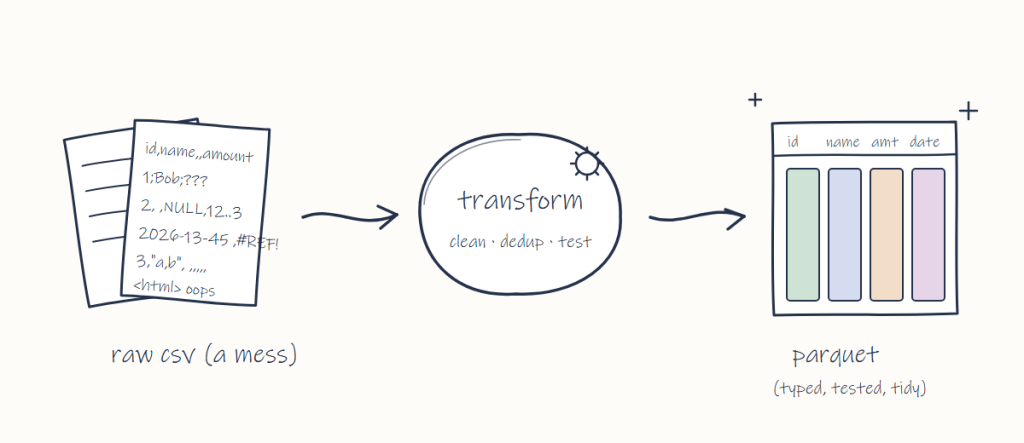
Let’s take a simple ETL job, read some CSV, clean it, and produce high quality Parquet files that humans and AI can consume.
From a human perspective, and although we like to think our judgement is based purely on cost and performance, that’s never really been the case. It is always influenced by personal bias: Spark people will always use Spark, T-SQL people will always use the DWH, and Pandas people don’t care, they will use their thing.
Now, if we imagine an AI doing that, the incentives are different. Yes, AI is biased by its training data, but it isn’t biased by tribe. Judging by my AI agent (I suspect it is telling me what I want to hear), it doesn’t care. It prefers short loops, and if you tell it “I want the cheapest option”, it is smart enough to try to do that.
1- ETL is just processing raw data into something coherent that can be consumed. It is a deterministic process, and as someone who mainly used GUI tools, it took me a while to get it: data engineering is just code!!! Those tools are writing code, it just happens that we don’t see it 🙂
2- All things considered, an AI agent has no personal attachment to an engine, assuming you give it a strict spec. An agent will not favour an engine because of familiarity, or because it spent so much time using it that it became tribal.
3- Opus 4.8 class AI is good enough for general purpose data engineering. The current issue is the cost. Right now you need a Max subscription in practise and it is just not sustainable, but I am confident the market will figure out a solution. We don’t need AGI, just a super cheap Opus 5 alternative 🙂
4- I am not saying all engines are equal, or that they become just a SQL runtime. That’s not true. But because the cost of switching from one SQL dialect to another is minimal, the human excuse of “I use what I know” (which is pretty tragic, when you think about it) will no longer be relevant.
Selecting an engine will be strictly based on facts: engine 1 can do efficient MERGE, engine 2 cannot, engine 1 wins. That’s fair.
And engines still have a lot to improve, see for example non-trivial incremental processing, async remote scans, partial caching, Dynamic Horizontal scaling etc.
And to be fair, the dialect alone is not the whole story. Subtle differences in engine behaviour, even when using the same SQL text, can be a pain. I learnt this the hard way. I spent too much time trying to debug a result, only to find out that two engines have different behaviour when doing a join using a word with padding: “spain” and “spain ” may or may not mean the same thing.
But the good thing is that a cross-engine parity check catches these subtleties automatically. Either the numbers match or they don’t (you can’t do that with Chat with your data).
5- Cloud storage vendors ultimately want to store more data, regardless of how it was processed — their incentives are aligned with this agentic trend. In my personal opinion, they need to spend less time on MCP and other AI stuff, and just focus on the boring stuff: authentication, documentation, and interoperability.
If you want to deviate from the catalog spec, at least spend some engineering time working with the open source engines to support your own variant.
6- The less a client has to do, the better for everyone: move more stuff to the catalog, including table scanning and server-side planning.
A read-only client has no interest in reading Avro files. Just give me a list of Parquet files and deletion vectors to read. Keep it opaque. Store it in a database, I don’t care. Just give me the data files to read.
7-I added this note because of early feedback on the blog, which was basically: “I don’t care about Iceberg, I use Delta.” That’s a fair reaction. The good news is it won’t really matter — Delta 5 will use the same adaptive metadata as Iceberg V4. They’re still two separate projects with different governance model(or rather, the lack of it), but ultimately they’ll produce the same thing in theory . Just give it another 2 years or so, there is a real table format fatigure, translating from one to another is a waste of everyone time, and to be honest, some vendors find it is much cheaper just to lock users using credential vending instead of weaponising the table format 🙂
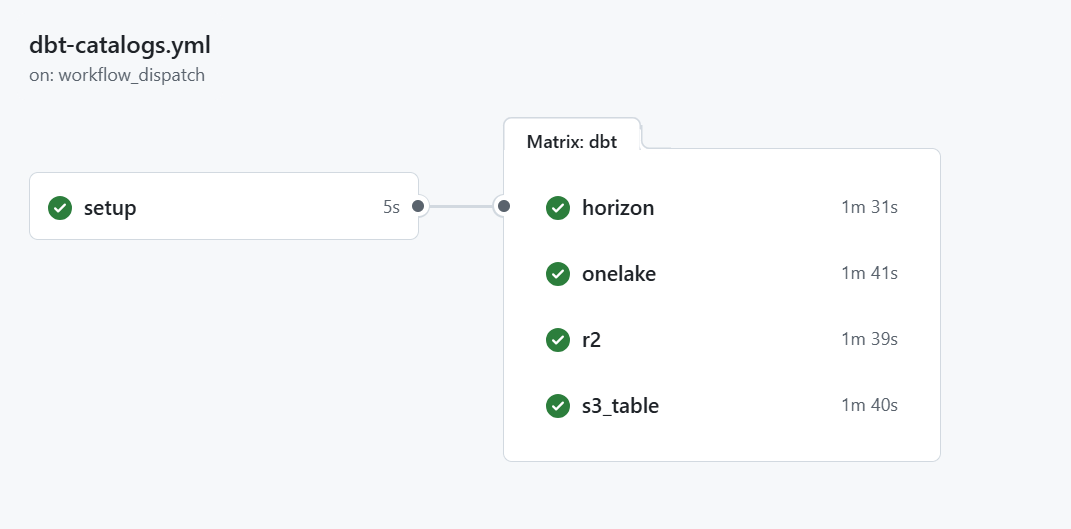
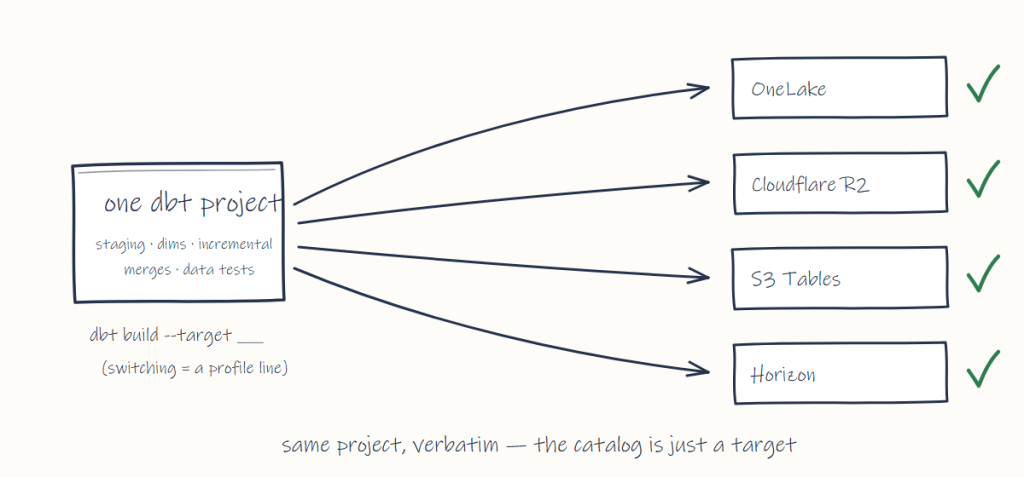
Instead of another abstract “thought leadership” blog post 🙂 here’s a concrete example: the same dbt project, unchanged, runs against four different vendors’ Iceberg REST catalogs: OneLake, Cloudflare R2, S3 Tables and Snowflake Horizon, each in about a minute, on a throwaway GitHub Actions runner with DuckDB as the engine.
Switching catalog is literally changing one ATTACH in profiles.yml.
The whole thing is public: testing-iceberg-rest-catalog.
Hopefully, data engineering will move away from configuring and fine-tuning engines and towards talking more to end users and understanding what they need: agreeing on what the numbers are supposed to mean, and writing the tests that catch it when they are wrong.
The machine can build the pipeline, and it will probably be better than us at it, but it doesn’t know what “correct” means. I was tempted to write something about ontology but I am not going there 🙂
And getting access to that ERP will always require a human. That’s an organizational thing, and no AI can fix it.
As a data analyst by trade, I always found data engineering a chore. I never enjoyed it , and to be honest ,it does not bother me if writing transformation becomes fully automated
So I have a bias, to be honest, and maybe this blog is just wishful thinking. But what if it is true? I think, at least, pay attention to this new trend.

