The Boring Reason Iceberg Matters

TL;DR: Iceberg’s value is sociological, not technical. And if you care about lightweight, single-process engines like datafusion and duckdb, it’s probably your best shot at first-class lakehouse support with Wide interoperability.

The first real data engineering work I did was an ingestion pipeline built on pandas and Parquet with Hive-style partitioning — an environment where 512 MB of memory was a genuine architectural constraint, not a rounding error. That experience shaped how I think about data tooling: the engine matters, but so does the ability to swap it out. Engine independence is something I care about more than most people I know, which is probably why I find myself paying close attention to Iceberg. Not for the reasons most people cite, though. It’s not the spec. It’s where the engineering hours are landing.

Getting query engines and catalogs to talk to each other is genuinely hard work. Most of it is unglamorous: error envelope parsing, metadata round-tripping, commit response shapes, partition spec edge cases, auth token quirks between vendors. None of it ships a feature anyone demos. None of it makes a good blog post. It’s the maintenance work that quietly determines whether your stack actually functions.

This is the part that’s easy to miss. Standards don’t converge because the spec is good. They converge because enough people, at enough companies, decide to put sustained hours into the interop bugs — year after year, across release cycles, through personnel changes and shifting priorities.

Look at the Iceberg committer list: Netflix, Apple, Databricks, Snowflake, AWS, Dremio, Microsoft. No single employer controls what gets merged. The incentive to fix cross-vendor interoperability bugs is distributed across the committer base itself. The governance isn’t just a formality — it’s what makes it possible for engineers from genuinely different setups to find, reproduce, and fix the same bug together.

There is one specific layer worth watching: the Iceberg REST catalog specification. It has become the canonical standard for how engines and catalogs communicate. Adoption is real: Polaris, lakekeeper, Gravitino, and a growing list of vendor-managed catalogs implement it.

But adoption and interoperability are not the same thing.

In practice, vendors still interpret parts of the specification differently. Engines end up handling quirks like slightly different response shapes, undocumented authentication flows, or inconsistent error handling. The nearest analogy is ODBC — a real standard, widely implemented, and still years of painful work before the “connect to anything” promise actually held up in practice.

The Iceberg REST catalog ecosystem feels earlier in that curve. The gap between specification and implementation is exactly where a lot of the maintenance work is happening right now. And closing that gap is precisely the kind of work Iceberg’s governance model is designed to support, because the people hitting the bugs are often the same people with commit access to fix them.

This is where the stakes become concrete, especially for lightweight engines.

For cloud warehouses and large JVM-based systems, the maintenance burden is manageable. There are full-time teams paid to absorb it. For the newer generation of small, single-process engines, the situation is very different. These are compact teams building engines with a specific focus: query latency, memory efficiency, embedded analytics, local execution.

Every hour spent chasing interoperability edge cases is an hour not spent improving the engine itself.

Several of these engines already support Iceberg in some form. But broad, reliable lakehouse support depends on the ecosystem doing its part: stable specifications, faithful implementations, bugs surfaced and fixed upstream.

A well-maintained standard is not just a convenience for these projects. It’s what makes serious lakehouse support achievable without hollowing out the team building the engine.

There is also a broader cost to fragmentation that rarely gets discussed directly. Every hour the ecosystem spends maintaining incompatible metadata layers is an hour not spent making lakehouse systems actually better. That cost doesn’t show up clearly in any individual issue tracker, but it accumulates across the entire ecosystem.

That’s the real argument for Iceberg.

Not that it’s a particularly clever format. Formats are mostly boring by design.

The real advantage is that Iceberg has assembled the right kind of maintenance coalition: enough companies with genuinely different incentives, governance that distributes merge authority, and enough independent implementations that bugs surface from the edges instead of only the center.

Whether that coalition survives long term as the market consolidates is still an open question. But right now, Iceberg is the ecosystem where the boring interoperability work is most likely to get done by someone other than you.

And in infrastructure, that’s close to everything.

That’s also why this feels personal to me.

The 512 MB pipeline I started with wrote Parquet files and hoped for the best — no transactions, no snapshot isolation, just partitions and careful scheduling to avoid stepping on yourself.

What I actually wanted, and couldn’t realistically have at the time, was proper ACID semantics with snapshot isloation end to end from something small and cheap. A cloud function. A tiny process with almost no memory to spare.

Iceberg is the closest thing to a realistic path toward that today. Not because the specification is especially elegant, but because it’s where the maintenance work is happening.

And eventually, ecosystems catch up to where the maintenance happens.


Special thanks to Raki Rahman for a few conversations that genuinely reshaped how I think about this space.

Ideas are mine; writing assisted by AI.

Python Engines current Onelake Catalog integration

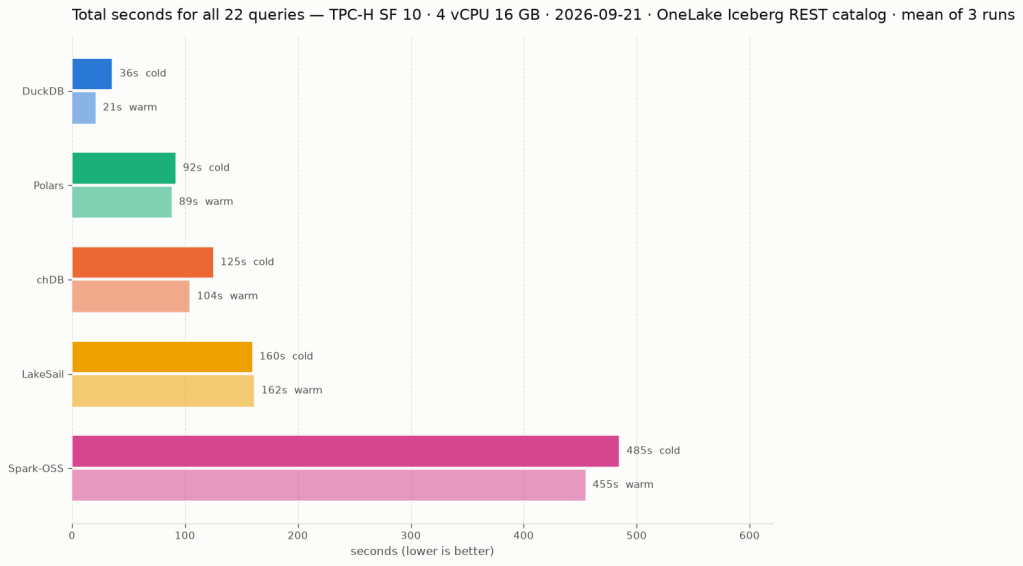
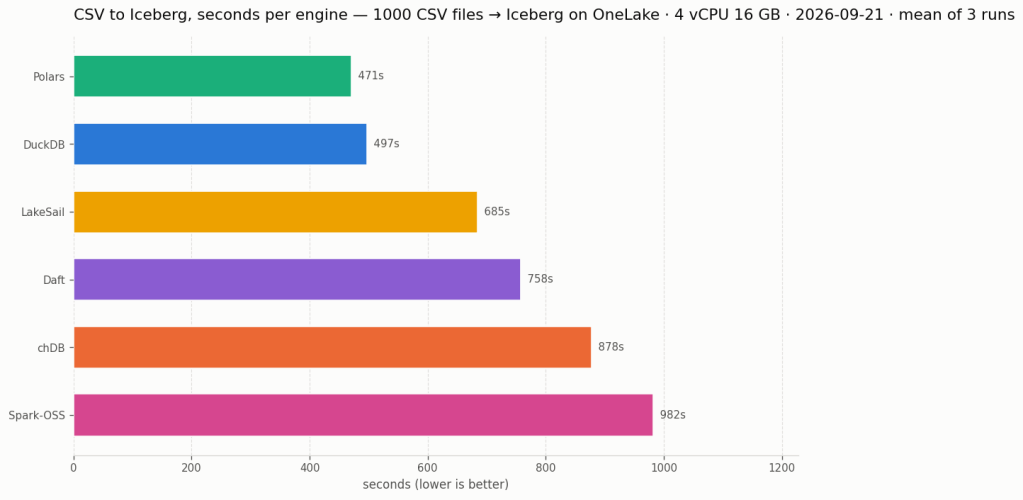
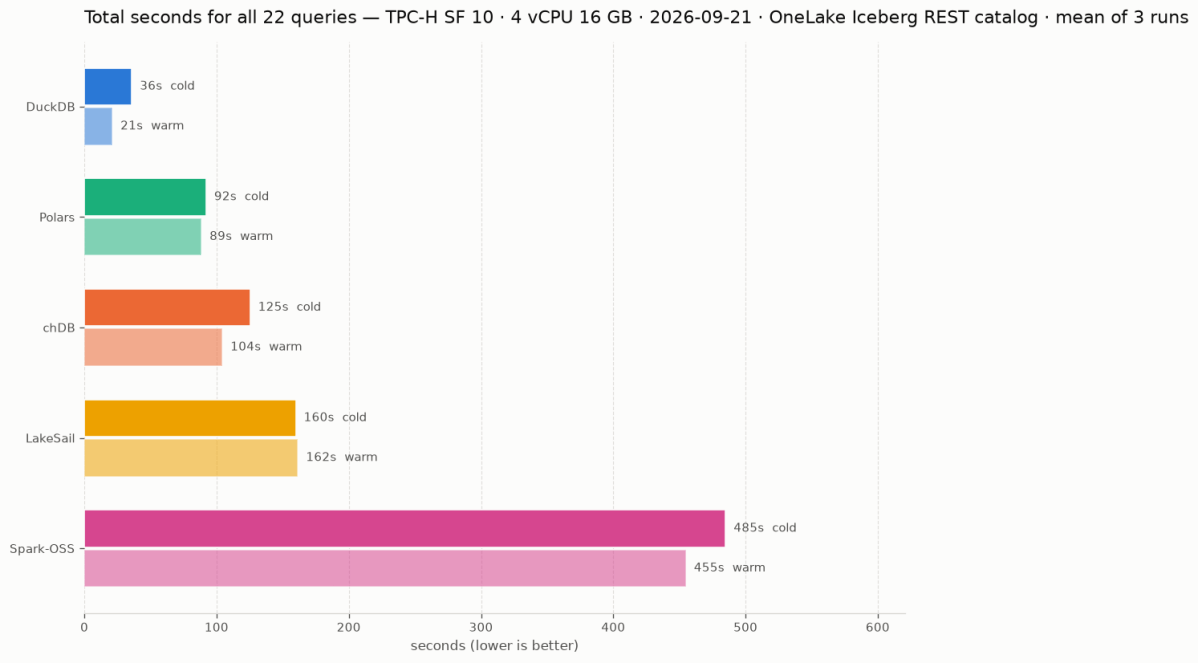
Same 22 TPC-H queries. Same Delta Lake data on OneLake (SF10). Same single Fabric node. Five Python SQL engines: DuckDB (Delta Classic), DuckDB (Iceberg REST), LakeSail, Polars, DataFusion , you can download the notebook here

unfortunately both daft and chdb did not support reading from Onelake abfss

DuckDB iceberg read support is not new, but it is very slow, but the next version 1.5 made a massive improvements and now it is slightly faster than Delta

They all run the same SQL now

All five engines executed the exact same SQL. No dialect tweaks, no rewrites. The one exception: Polars failed on Query 11 with

`SQLSyntaxError: subquery comparisons with '>' are not supported`

Everything else just worked,SQL compatibility across Python engines is basically solved in 2026. The differentiators are elsewhere.

Freshness vs. performance is a trade-off you should be making

import duckdb
conn = duckdb.connect()
conn.sql(f""" install delta_classic FROM community ;
attach 'abfss://{ws}@onelake.dfs.fabric.microsoft.com/{lh}.Lakehouse/Tables/{schema}'
AS db (TYPE delta_classic, PIN_SNAPSHOT); USE db
""")

`MAX_TABLE_STALENESS ‘5 minutes’` means the engine caches the catalog metadata and skips the round-trip for 5 minutes.

DuckDB’s Delta Classic does the same with `PIN_SNAPSHOT`.

import duckdb
conn = duckdb.connect()
conn.sql(f""" install delta_classic FROM community ;
attach 'abfss://{ws}@onelake.dfs.fabric.microsoft.com/{lh}.Lakehouse/Tables/{schema}'
AS db (TYPE delta_classic, PIN_SNAPSHOT); USE db
""")

Your dashboard doesn’t need sub-second freshness. Your reporting query doesn’t care about the last 30 seconds of ingestion. Declaring a staleness budget upfront – predictable, explicit – is not a compromise. It’s the right default for analytics.

Object store calls are the real bottleneck

Every engine reads from OneLake over ABFSS. Every Parquet file is a network call. It doesn’t matter how fast your engine scans columnar data in memory if it makes hundreds of HTTP calls to list files and read metadata before it starts.

DuckDB Delta Classic (PIN_SNAPSHOT): caches the Delta log and file list at attach time. Subsequent queries skip the metadata round-trips.

DuckDB Iceberg (MAX_TABLE_STALENESS): caches the Iceberg snapshot from the catalog API. Within the staleness window, no catalog calls.

LakeSail: has native OneLake catalog integration (SAIL_CATALOG__LIST). You point it at the lakehouse, it discovers tables and schemas through the catalog. Metadata resolution is handled by the catalog layer, not by scanning storage paths, but it has no concept of cache, every query will call Onelake Catalog API

Polars, DataFusion: resolve the Delta log on every query. Every query pays the metadata tax.

An engine that caches metadata will beat a “faster” engine that doesn’t. Every time, especially at scale.

How about writes?

You can write to OneLake today using Python deltalake or pyiceberg – that works fine. But native SQL writes (CREATE TABLE AS INSERT INTO ) through the engine catalog integration itself? That’s still the gap, lakesail can write delta just fine but using a path.

LakeSail and DuckDB Iceberg both depend on OneLake’s catalog adding write support. The read path works through the catalog API, but there’s no write path yet. When it lands, both engines get writes for free.

DuckDB Delta Classic has a different bottleneck: DuckDB’s Delta extension itself. Write support exists but is experimental and not usable for production workloads yet.

The bottom line

Raw execution speed will converge. These are all open source projects, developers read each other’s code, there’s no magical trick one has that others can’t adopt. The gap narrows with every release.

Catalog Integration and cache are the real differentiator. And I’d argue that even *reading* from OneLake is nearly solved now.

Full disclosure: I authored the DuckDB Delta Classic extension and the LakeSail OneLake integration (both with the help of AI), so take my enthusiasm for catalog integration with a grain of bias

Query Onelake Iceberg REST catalog using Duckdb SQL

it is a quick post on how to query Onelake Iceberg REST Catalog using pure SQL with DuckDB, and yes you need a service principal that has access to the lakehouse

CREATE or replace PERSISTENT secret onelake_identity_iceberg (
    TYPE ICEBERG,
    CLIENT_ID 'xxxxxxxxxxxxxx',
    CLIENT_SECRET 'yyyyyyyyyyyyyyyyyyy' ,
    OAUTH2_SCOPE   'https://storage.azure.com/.default' ,
    OAUTH2_SERVER_URI 'https://login.microsoftonline.com/TENANT_ID /oauth2/v2.0/token' ,
    ENDPOINT 'https://onelake.table.fabric.microsoft.com/iceberg'
);
CREATE or replace PERSISTENT secret azure_spn (
    TYPE azure,
    PROVIDER service_principal,
    TENANT_ID 'ccccccc',
    CLIENT_ID 'iiiiiiiiiiiiii',
    CLIENT_SECRET 'xbndlfrewi' ,
    ACCOUNT_NAME 'onelake'
);

it works reasonably well assuming your region is not far from your laptop, or even better , if you run it inside Fabric then there is no network shenanigans, I recorded a video showing my experience

Why read operations do not always need full consistency checks

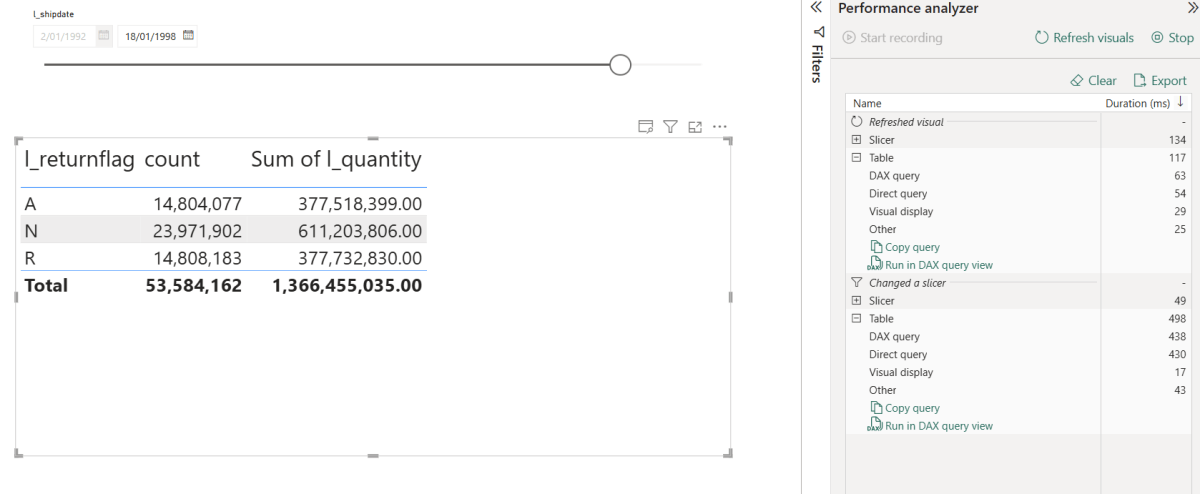
I hope DuckDB eventually adds an option that allows turning off table state checks for purely read scenarios. The current behaviour is correct because you always need the latest state when writing in order to guarantee consistency. However, for read queries it feels unnecessary and hurts the overall user experience. PowerBI solved this problem very well with its concept of framing, and something similar in DuckDB would make a big difference, notice duckdb delta reader already support pin version.

Stress Testing Iceberg shortcut in Onelake

TL;DR: Shared a notebook showing the results of Iceberg metadata conversion to Delta in Onelake.

I’ve been following the evolution of Iceberg shortcuts to OneLake and I’m genuinely impressed with how the engineering team has invested so much energy into making it more robust, it is a good idea to read the documentation.

Essentially, XTable is used behind the scenes. Think of it as a translator for your open table format. Instead of requiring you to convert data from one format (like Iceberg) to another (like Delta) just to query them together, XTable allows you to access and interact with tables in different formats as if they were a single, unified table within OneLake—all without user intervention.

To truly put this to the test, I recently ran an experiment in a real production environment using my paid tenant—no sandboxes here! Here’s the logic from the Python notebook:

  • Accessing data from an Iceberg table using a shortcut (sourced from Snowflake; the data can be stored anywhere—Azure, S3, GCP, or OneLake, You can use BigQuery too or any Iceberg writer).
  • Inserting arbitrary data and performing delete operations.
  • Counting the total rows using Snowflake.
  • Counting the total rows using Fabric notebook as a Delta Table.
  • Recording the record counts in a results table to track and visualize the comparison over time.

The results were quite awesome. I plotted the total record counts from both the Iceberg and Delta perspectives using two distinct colors and observed a perfect match. This confirms the seamless interoperability provided by XTable.


Lesson learned:

See the code snippet below for inserting data in Snowflake:

snow.execute(f'insert into ONELAKE.ICEBERG.scada select * from ONELAKE.AEMO.SCADARAW limit {limit};')
snow.execute('delete from ONELAKE.ICEBERG.scada where INITIALMW = 0')
snow.execute("SELECT SYSTEM$GET_ICEBERG_TABLE_INFORMATION('ONELAKE.iceberg.scada');")

In rare cases—especially when running multiple transactions at the same time—Snowflake may not instantly generate the metadata. To be 100% sure, run this SQL statement

SELECT SYSTEM$GET_ICEBERG_TABLE_INFORMATION('Table_name')

to force the engine to write new Iceberg metadata. It’s an annoying aspect of Iceberg: every commit generates three files. That’s a bit excessive. Some engines prefer to group multiple commits to reduce the size of the metadata. Again, it’s rare—but it does happen.