This post, the repo and every number in it are personal opinion. Nothing here is a Fabric position, benchmark or recommendation.
My colleague Eiki published a post on Microsoft’s white paper on Power BI architecture choices for Azure Databricks. Read it first: it covers the four storage modes, the headline findings, and links to the paper. I assume you know what the paper measured.
I like the paper for a different reason. It benchmarks a lakehouse as designed: open files on object storage, one vendor writes, another reads, Parquet is the only contract. Such benchmarks are rare, hard to reproduce and usually opinionated. This one is deliberately neutral (maybe too neutral) , The dataset is so uniform that V-Order has little room to differentiate the writers, so all writers start on relatively equal ground.
I have written before about VertiPaq reading Parquet that other engines wrote: Optimizing Parquet Layout for Power BI Direct Lake Mode (Dec 2024), Just VOrder, don’t try to understand how VertiPaq works (Nov 2025) and Writing Parquet That VertiPaq Likes (Aug 2026).
The short version: VertiPaq reads Parquet from any producer. It does not need V-Order. It prefers a layout it can transcode fast and hold small, and V-Order is one way to produce it.
This post applies that idea to Spark on Databricks. I am not a Spark expert; I know delta-rs much better. The Parquet concepts carry over, the knobs do not, and Databricks has many settings that interact.
AI helped me navigate them. Where the repo gets Spark wrong, the mistake is mine. Corrections welcome.
What I did
The paper tunes the Databricks write with the mainstream, documented settings, as an industry paper has to. This is a personal blog, so I can be less orthodox and go low level 🙂 I tried a few little-known knobs instead.
All of them are cluster configuration for row-group size and dictionary encoding, the same lines for every table, plus one optional step per fact table: a single clustering key on the column the reports filter on (nothing fancy it is just a global sort).
I used the paper’s protocol: TPC-DS at SF100 and SF1000, its DAX capture, 20 concurrent readers, three load tests back to back on one model. Two changes: the semantic model is deleted after the three runs so the next run starts cold, and the OneLake cache is on because my Databricks tenant is in another region. Only the very first run at a scale factor reads across regions; every later run 1 reads from the cache, so it measures the transcode alone.
Note: I used Fabric layout as it is.
Databricks writes, Direct Lake reads through the mirrored catalog. The configuration, what each line does and what breaks it are in the repo. This post is results only.
The results
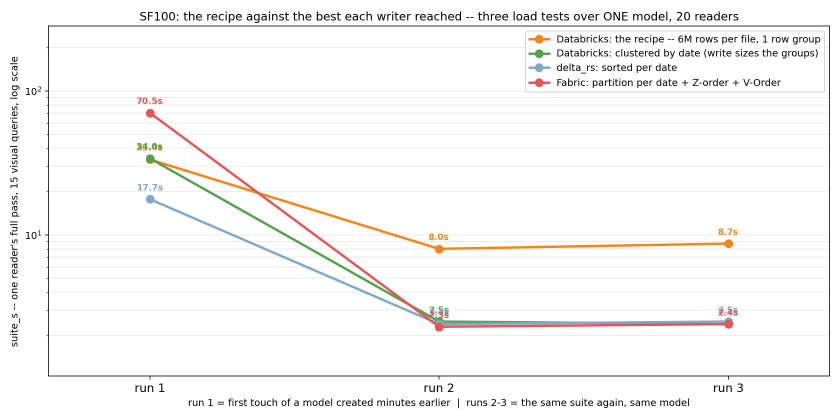
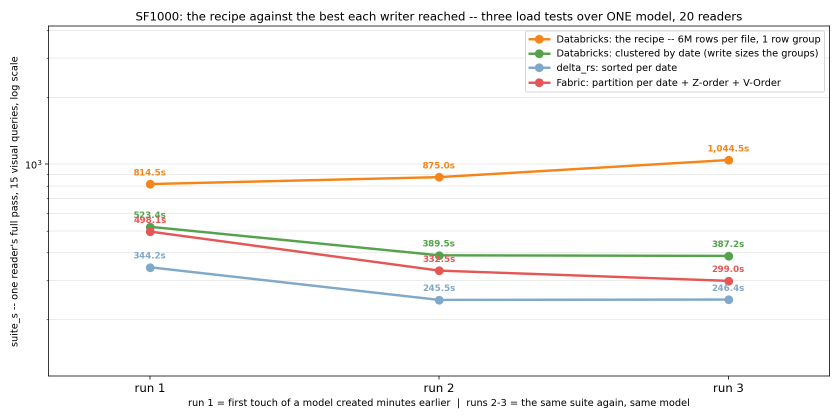
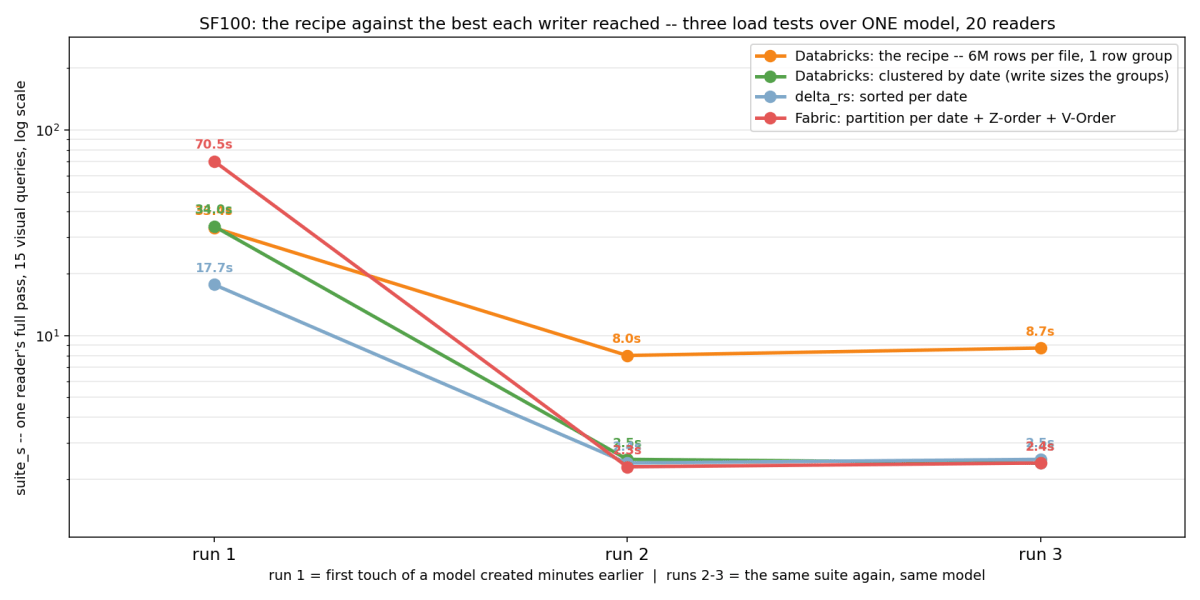
Each chart shows the configuration alone, the configuration with the clustering key, and the best layout of each other writer: delta-rs sorted on the date key, and the paper’s Fabric layout of one partition per date with Z-order and V-Order.
Run 1 pays the transcode; runs 2 and 3 rerun the same queries on the loaded model.
At SF100, the configuration alone produces dictionary encoding and large row groups, but is about three times slower than every ordered layout. Adding the clustering key on the date matches the paper’s V-Order layout, with row groups more than ten times larger.
At SF1000, the configuration alone never really warms up: each run is slower than the last, while the three ordered layouts do. That is why the clustering key is not just an optimisation in the recipe; it is what makes the layout usable at this scale. The clustered arm still trails delta-rs and the paper’s layout at SF1000: the clustering did not fully sort the rows at that scale, and the repo carries that as open. Why delta-rs has the best cold run at both scale factors is still a mystery to me.
The interesting part is that VertiPaq does not care who wrote the Parquet. It cares about the physical layout it has to transcode.
The repo
github.com/djouallah/parquet_layout_vertipaq_spark has the configuration, the clustering step, what undoes it, the numbers behind both charts and what is still open.
It also ships a Claude Code skill that applies the recipe.

