Edit : I vibe coded one, so you dont need to read this whole text
https://djouallah.github.io/fabric-context-layer
As a data analyst, I have been following the progress of LLMs in analytics, and although there has been some progress in accuracy and in the kinds of questions you can ask, overall, it hasn’t had the impact I was hoping for. That’s a totally different story for coding and data engineering, where AI is already changing daily workflows. The core idea is simple: if something is falsifiable, AI can be useful.
In the last couple of months, I keep hearing about some new terms which I never really understood: knowledge graphs, ontology (Andre, who is someone I respect a lot calls it the Enterprise brain), and so on. But I think there may be something genuinely interesting here for analytics.
There is so much data in an enterprise, and so much of it is still underused. Talking about a context layer is not new, and there is plenty of literature on it, but it is rare to see it from the end user perspective.
There are mainly two approaches. One requires modelling, which instinctively bothers me because it expects me to do more work upfront. Maybe it is an age thing, but I am not particularly excited about learning a new mental model. I have been doing semantic modelling for nearly a decade and I am quite happy with it.
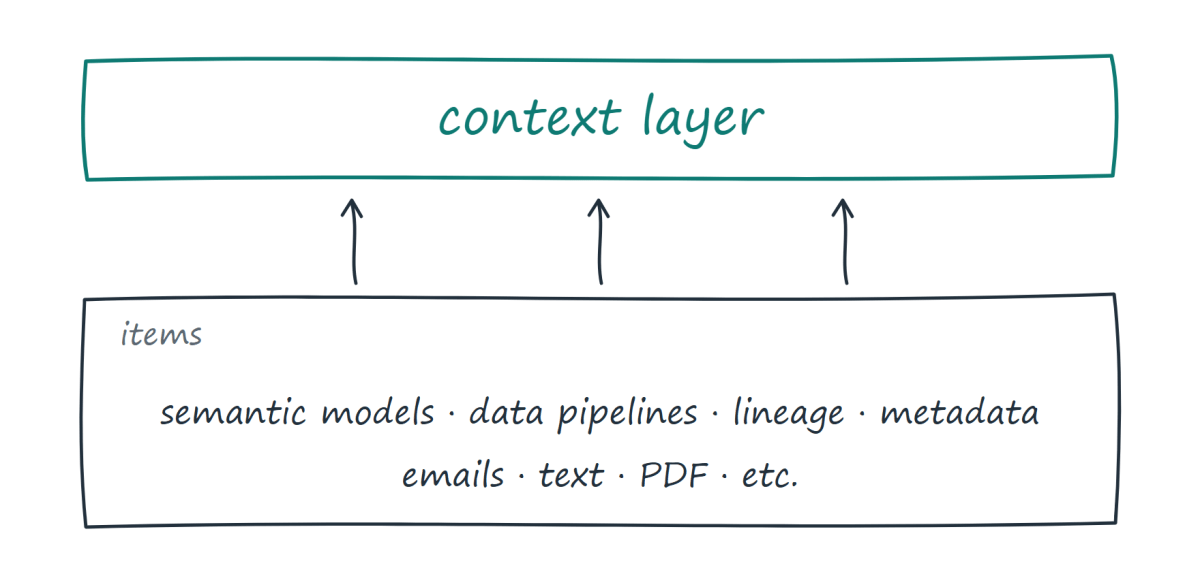
The other approach is more interesting to me because it doesn’t ask users to create something new. It works with what they already have: semantic models, data pipelines, the data itself, unstructured data, PDFs, folders, and so on. It figures out what already exists and how the pieces relate to each other. When you ask a question, it helps route you to the right place.
There is no magic here. To get a correct answer, you still need the hard work that has already been done: good semantic modelling, good metadata, good data, and so on.
For me, a system that can simply pick the right dashboard to use is already extremely useful. In a data platform, sometimes we don’t even know where to ask a question or which dashboard is more useful than another, unless we ask an analyst or a colleague. In a sense, this is just formalising what already happens in real life.
Even if the system says, “This is the question people are asking, and I don’t know of a good answer,” that’s already very useful feedback for analysts.
And one may argue, what if two semantic models authored by different departments don’t have the same definition? A naive answer would be to create one giant semantic model that unifies everything, which will never happen because this is fundamentally a human and organisational problem, not a technical one.
Maybe the better approach is simply to formalise what we already do today. Whatever the CEO, manager, or wider organisation is actually using probably makes more sense to prioritise, regardless of whether it is objectively the truth. We can imagine the system using signals: a certified dataset might carry more weight, or perhaps the author of a dataset has more credibility.
This is not a problem specific to analytics. Ask two news channels to describe the same event and you will often get different interpretations.
But to be super clear, the numbers themselves should never be non-deterministic. The measures are authored in exisitng semantic models, not made up on the fly
The bigger idea is that the context could improve with usage. Data platforms already have an enormous amount of telemetry. They know who uses what, which reports are popular, which datasets are trusted, and which questions people keep asking. There is nothing particularly new about this data. What is new is the possibility of using it to help both agents and humans find answers based on what the organisation actually uses and trusts.
In other words, the context isn’t something you build once and then leave alone. It could continuously evolve based on how the organisation actually works.
Users, I think, will not care how those signals are calculated. Users are selfish (speaking for myself here) and care only whether it is useful or not. Companies may want a say in what gets prioritised and how it works, or they may want to export that knowledge somewhere else. But I suspect they will mostly be happy if it just works.
I think the reason this may work now is that AI is becoming good enough for a lot of things. What it needs is not necessarily more intelligence, but better grounding in the knowledge that already exists inside an organisation.
I came from the construction industry, and we had this thing called delay analysis. It is basically an attempt to prove that a project delay is not the contractor’s fault. Maybe the client kept changing requirements, failed to approve drawings on time, or introduced other changes that affected the schedule.
Companies spend a lot of money on consultants who come in, read thousands of documents and pieces of correspondence, and try to rebuild a simplified model of what happened.
I know this is a very specific example, but I think AI should be able to solve this surprisingly well.
I can imagine a data platform where a supervisor asks, “What’s going on? Why are we late?” and gets an answer based on the actual project data, with references to the relevant dashboard, emails, RFIs, documents, and other evidence.
That is the kind of thing I would pay money for.
Maybe that’s what an enterprise context layer really is: not another model people have to maintain, but a way of making the knowledge an organisation already has actually useful. I am not saying this is a solved problem, or even that it will work in practice, but I think it is something worth building.

