A Non-scientific Benchmark of Text-to-SQL using Small Language Models

TL;DR ; This post shares a quick experiment I ran to test how effective (or ineffective) small language models are at generating SQL from natural language questions when provided with a well-defined semantic model. It is purely an intellectual curiosity; I don’t think we are there yet. Cloud Hosted LLMs are simply too good, efficient, and cost-effective.

You can download the notebook and the semantic model here.

⚠️ This is not a scientific benchmark.
I’m not claiming expertise here—just exploring what small-scale models can do to gain an intuition for how they work. Large language models use so much computational power that it’s unclear whether their performance reflects true intelligence or simply brute force. Small-scale models, however, don’t face this issue, making their capabilities easier to interpret.

Introduction

I used Ollama to serve models locally on my laptop and DuckDB for running the SQL queries. DuckDB is just for convenience—you could use any SQL-compatible database

For a start I used Qwen3, 4B, 8B and 14B, it is open weight and I heard good reviews considering it’s size, but the same approach will works with any models, notice I turn off thinking mode in Qwen.

To be honest, I tested other small models too, and they didn’t work as well. For example, they couldn’t detect my graphics card. I probably missed some configuration, but since I don’t know enough, I prefer to leave it at that.

0. Semantic Model Prompt


A semantic_model.txt file acts as the system prompt. This guides the model to produce more accurate and structured SQL outputs , the semantic model itself was generated by another LLM, it does include non trivial verified SQL queries ,sample values, relationships , measures etc, custom instructions

“no_think” is to turn off the thinking mode in Qwen3

1. Setup and Environment

  • The notebook expects an Ollama instance running locally, with the desired models (like qwen3:8b, qwen3:4b) already pulled using ollama run <model_name>.

2. How It Works

Two main functions handle the process:

  • get_ollama_response:
    This function takes your natural language question, combines it with the semantic prompt, sends it to the Local Ollama server, and returns the generated SQL.
  • execute_sql_with_retry:
    It tries to run the SQL in DuckDB. If the query fails (due to syntax or binding errors), it asks the model to fix it and retries—until it either works or hits a retry limit.

In short, you type a question, the model responds with SQL, and if it fails, the notebook tries to self-correct and rerun.

3. Data Preparation

The data was generated using a Python script with a scale factor (e.g., 0.1). If the corresponding DuckDB file didn’t exist, the script created one and populated it with the needed tables. Again, the idea was to keep things lightweight and portable.

Figure: Example semantic model

4. Testing Questions

Here are some of the questions I tested, some are simple questions others a bit harder and require more efforts from the LLM

  • “total sales”
  • “return rate”
  • “Identify the top 10 item categories with the highest total return amount from customers born in ‘USA’ who made returns in 2001.”
  • “customer age group with the worst return rate?”
  • “return rate per year”
  • “any days with unusual return rate?, use fancy statistics”

Each question was sent to different models (qwen3:14b, qwen3:8b, qwen3:4b) to compare their performance. I also used %%time to measure how long each model took to respond, some questions were already in the semantic model, verified query answers, so in a sense it is a test too to see how the model stick with the instruction


5. What Came Out

For every model and question, I recorded:

  • The original question
  • Any error messages and retries
  • The final result (or failure)
  • The final SQL used
  • Time taken per question and total time per model

6. Observations

Question 6 : about detecting unusual return rates with “fancy statistics “stood out:

  • 8B model:
    Generated clean SQL using CTEs and followed a star-schema-friendly join strategy. No retries needed.
  • 14B model:
    Tried using Z-scores, but incorrectly joined two fact tables directly. This goes against explicit instruction in the semantic model.
  • 4B model:
    Couldn’t handle the query at all. It hit the retry limit without producing usable SQL.

By the way, the scariest part isn’t when the SQL query fails to run, it’s when it runs, appears correct, but silently returns incorrect results

Another behavior which I like very much, I asked a question about customers born in the ‘USA’, the model was clever enough to leverage the sample values and use ‘UNITED STATES’ instead in the filter.

Execution Times

  • 14B: 11 minutes 35 seconds
  • 8B: 7 minutes 31 seconds
  • 4B: 4 minutes 34 seconds

Tested on a laptop with 8 cores, 32 GB RAM, and 4 GB VRAM (Nvidia RTX A2000), the data is very small all the time is spent on getting the SQL , so although the accuracy is not too bad, we are far away from interactive use case using just laptop hardware.

7- Testing with simpler questions Only

I redone the test with 4B but using only simpler questions :

questions = [
          'total sales',
          'return rate',
          "Identify the top 10 item categories with the highest total return amount from customers born in 'USA' who made returns in 2001.",
          'return rate per year',
          'most sold items',
          ]
ask_question(questions,'qwen3:4b')

the 5 questions took less than a minutes, that promising !!!

Closing Thought

instead of a general purpose SLM, maybe a coding and sql fine tuned model with 4B size will be an interesting proposition, we live in an interesting time

Vibe Coding a Simple SQL orchestrator in a Fabric Python Notebook

Note: The blog and especially the code were written with the assistance of an LLM.

TL;DR

I built a simple Fabric Python notebook to orchestrate sequential SQL transformation tasks in OneLake using DuckDB and delta-rs. It handles task order, stops on failure, fetches SQL from external sources (like GitHub or a Onelake folder), manages Delta Lake writes, and uses Arrow recordbacth for efficient data transfer, even for large datasets. This approach helps separate SQL logic from Python code and simulates external table behavior in DuckDB. Check out the code on GitHub: https://github.com/djouallah/duckrun

pip install duckrun

Introduction

Inspired by tools like dbt and sqlmesh, I started thinking about building a simple SQL orchestrator directly within a Python notebook. I was showing a colleague a Fabric notebook doing a non-trivial transformation, and although it worked perfectly, I noticed that the SQL logic and Python code were mixed together – clear to me, but spaghetti code to anyone else. With Fabric’s release of the user data function, I saw the perfect opportunity to restructure my workflow:

  • Data ingestion using a User-Defined Function (UDF), which runs in a separate workspace.
  • Data transformation in another workspace, reading data from the ingestion workspace as read-only.
  • All transformations are done in pure SQL, there 8 tables, every table has a sql file, I used DuckDB, but feel free to use anything else that understands SQL and output arrow (datafusion, chdb, etc).
  • Built Python code to orchestrate the transformation steps.
  • PowerBI reports are in another workspace

I think this is much easier to present 🙂

I did try yato, which is a very interesting orchestrator, but it does not support parquet materialization

How It Works

The logic is pretty simple, inspired by the need for reliable steps:

  1. Your Task List: You provide the function with a list (tasks_list). Each item has table_name (same SQL filename, table_name.sql) and how to materilize the data in OneLake (‘append’ , ‘overwrite’,ignore and None)
  2. Going Down the List: The function loops through your tasks_list, taking one task at a time.
  3. Checking Progress: It keeps track of whether the last task worked out using a flag (like previous_task_successful). This flag starts optimistically as True.
  4. Do or Don’t: Before tackling the current task, it checks that flag.
  • If the flag is True, it retrieves the table_name and mode from the current task entry and passes them to another function, likely called run_sql. This function performs the actual work of running your transformation SQL and writing to OneLake.
  • If the flag is False, it knows something went wrong earlier, prints a quick “skipping” message, and importantly, uses a break statement to exit the loop immediately. No more tasks are run after a failure.
  1. Updating the Status: After run_sql finishes, run_sql_sequence checks if run_sql returned 1 (our signal for success). If it returns 1, the previous_task_successful flag stays True. If not, the flag flips to False.
  2. Wrap Up: When the loop is done (either having completed all tasks or broken early), it prints a final message letting you know if everything went smoothly or if there was a hiccup.

The run_sql function is the workhorse called by run_sql_sequence. It’s responsible for fetching your actual transformation SQL (that SELECT … FROM raw_table). A neat part here is that your SQL files don’t have to live right next to your notebook; they can be stored anywhere accessible, like a GitHub repository, and the run_sql function can fetch them. It then sends the SQL to your DuckDB connection and handles the writing part to your target OneLake table using write_deltalake for those specific modes. It also includes basic error checks built in for file reading, network stuff, and database errors, returning 1 if it succeeds and something else if it doesn’t.

You’ll notice the line con.sql(f””” CREATE or replace SECRET onelake … “””) inside run_sql; this is intentionally placed there to ensure a fresh access token for OneLake is obtained with every call, as these tokens typically have a limited validity period (around 1 hour), keeping your connection authorized throughout the sequence.

When using the overwrite mode, you might notice a line that drops DuckDB view (con.sql(f’drop VIEW if exists {table_name}’)). This is done because while DuckDB can query the latest state of the Delta Lake files, the view definition in the current session needs to be refreshed after the underlying data is completely replaced by write_deltalake in overwrite mode. Dropping and recreating the view ensures that subsequent queries against this view name correctly point to the newly overwritten data.

The reason we do this kind of hacks is, duckdb does not support external table yet, so we are just simulating the same behavior by combining duckdb and delta rs, spark obviousely has native support

Handling Materialization in Python

One design choice here is handling the materialization strategy (whether to overwrite or append data) within the Python code (run_sql function) rather than embedding that logic directly into the SQL scripts.

Why do it this way?

Consider a table like summary. You might have a nightly job that completely recalculates and overwrites the summary table, but an intraday job that just appends the latest data. If the overwrite or append command was inside the SQL script itself, you’d need two separate SQL files for the exact same transformation logic – one with CREATE OR REPLACE TABLE … AS SELECT … and another with INSERT INTO … SELECT ….

By keeping the materialization mode in the Python run_sql function and passing it to write_deltalake, you can use the same core SQL transformation script for the summary table in both your nightly and intraday pipelines. The Python code dictates how the results of that SQL query are written to the Delta Lake table in OneLake. This keeps your SQL scripts cleaner, more focused on the transformation logic itself, and allows for greater flexibility in how you materialize the results depending on the context of your pipeline run.

Efficient Data Transfer with Arrow Record batch

A key efficiency point is how data moves from DuckDB to Delta Lake. When DuckDB executes the transformation SQL, it returns the results as an Apache Arrow RecordBatch. Arrow’s columnar format is highly efficient for analytical processing. Since both DuckDB and the deltalake library understand Arrow, data transfers with minimal overhead. This “zero-copy” capability is especially powerful for handling datasets larger than your notebook’s available RAM, allowing write_deltalake to process and write data efficiently without loading everything into memory at once.

Example:

you pass Onelake location, schema and the number of files before doing any compaction

first it will load all the existing Delta table

Here’s an example showing how you might define and run different task lists for different scenarios:

sql_tasks_to_run_nightly = [
    ['price', 'append'],
    ['scada', 'append'],
    ['duid', 'ignore'],
    ['summary', 'overwrite'], # Overwrite summary nightly
    ['calendar', 'ignore'],
    ['mstdatetime', 'ignore'],
]

sql_tasks_to_intraday = [
    ['price_today', 'append'],
    ['scada_today', 'append'],
    ['duid', 'ignore'],
    ['summary', 'append'] # Append to summary intraday using the *same* SQL script
]


You can then use Python logic to decide which pipeline to run based on conditions, like the time of day:

start = time(4, 0)
end = time(5, 30)

if start <= now_brisbane <= end:
    run_sql_sequence(sql_tasks_to_run_nightly)

Here’s an example of an error I encountered during a run, it will automatically stop the remaining tasks:

Attempting to run SQL for table: price_today with mode: append
Running in mode: append for table: price_today
Error writing to delta table price_today in mode append: Parser Error: read_csv cannot take NULL list as parameter
Error updating data or creating view in append mode for price_today: Parser Error: read_csv cannot take NULL list as parameter
Failed to run SQL for table: price_today. Stopping sequence.
One or more SQL tasks failed.

here is some screenshots from actual runs

as it is a delta table, I can use SQL endpoints to get some stats

For example the table scada has nearly 300 Million rows, the raw data is around 1 billion of gz.csv

It took nearly 50 minutes to process using 2 cpu and 16 GB of RAM, notice although arrow is supposed to be zero copy, writing parquet directly from Duckdb is substantially faster !!! but anyway, the fact it works at all is a miracle 🙂

in the summary table we remove empty rows and other business logic, which reduce the total size to 119 Million rows.

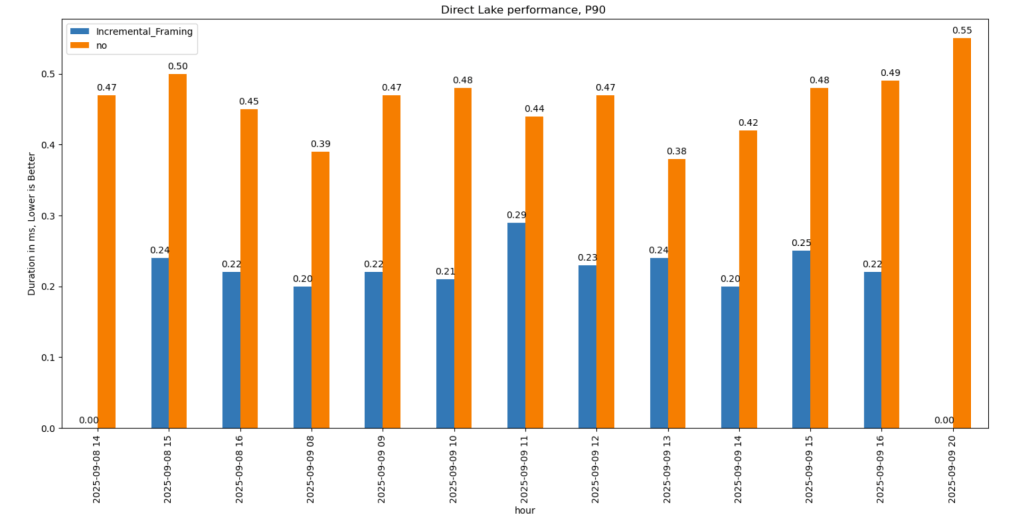
here is an example report using PowerBI direct lake mode, basically reading delta directly from storage

In this run, it did detect that the the night batch table has changed

Conclusion

To be clear, I am not suggesting that I did anything novel, it is a very naive orchestrator, but the point is I could not have done it before, somehow the combination of open table table format, robust query engines and an easy to use platform to run it make it possible and for that’s progress !!!

I am very bad at remembering python libraries syntax but with those coding assistants, I can just focus on the business logic and let the machine do the coding. I think that’s good news for business users.

An Excel User’s Perspective on Lakehouse Architecture

This is more or less the industry consensus on how a Lakehouse architecture should look in 2025.

By now, it’s become clear that Parquet is the de facto standard for storing data, and using an object store to separate storage from compute makes a lot of sense.

Another interesting development is how vendors want to package this offering. Storage vendors saw an opportunity to do more—after all, there’s no law that says the metastore belongs to the data warehouse! So you get things like S3 Table and Cloudflare R2, which I think is a good thing, especially if you’re a smaller analytics vendor. Life becomes much easier when table maintenance is done upstream, allowing you to focus solely on making the query engine faster.

Encouraging things are also happening in the table format space. I know a bit about Iceberg and Delta, but not much about the others. One very interesting development is Iceberg adopting deletion vectors from Delta in the V3 spec, while Delta will requires a catalog for read and write (at least for catalog managed table). I like to call it the “Icebergification” of Delta.

Another trend is the Delta Java writer making it easier to auto-generate Iceberg metadata. and Xtable is doing the same regardless of the delta writer, At this stage, one could argue: why do we need two table formats that are becoming virtually identical?

Data Analyst—How About Me?

These improvements mostly impact the write path, which is primarily managed by data engineers. But what about data analysts and end users?

if you have Fabric OneLake, you can use Direct Lake in OneLake mode. Marco has a great article about it. It’s a fantastic improvement compared to the initial version of Direct Lake. However, it doesn’t solve the problem if your data is hosted in an S3 table or BigQuery Iceberg table. Yes, you can create a shortcut to OneLake and read it from there, but that still depends on a data engineer setting it up.

Now imagine a world where an Excel, Tableau, or Power BI Desktop user (or any arbitrary client tool) can just point to a Lakehouse using a standard API, discover tables, read data, and build reports. Honestly, this isn’t a big ask , we already have this when connecting to databases using ODBC, and I don’t see any technical reason why we can’t have the same experience with Lakehouses.

We Already Have This API

For me, the most promising development in the Lakehouse ecosystem is the Iceberg Catalog REST API, and I genuinely hope it becomes a standard—just like ODBC is today (and hopefully ADBC in the future, but that’s another topic).

Again, speaking as a data analyst, I want my tools to support the read part of the API—just the ability to list tables and scan a table. That’s all. I have zero interest in how the data is stored or which table format is used. The catalog should be smart enough to generate metadata on the fly.

The Good News

We’re getting there—at least if you’re using a Python notebook. Here’s an example where I use the same Iceberg REST API to query a table from four different Lakehouse implementations using Daft.

def connect_catalog(cat):
  match cat:
    case 'polaris':
      catalog = load_catalog(
              'default',
              uri= polaris_endpoint,
              warehouse='dwh',
              scope = 'PRINCIPAL_ROLE:data_engineer' ,
              credential= polaris_key
            )
    case 's3':
      catalog = load_catalog(
              'default',
              **{
                "type": "rest",
                "warehouse": s3_warehouse ,
                "uri": "https://s3tables.us-east-2.amazonaws.com/iceberg",
                "rest.sigv4-enabled": "true",
                "rest.signing-name": "s3tables",
                "rest.signing-region": "us-east-2"
              }
            )
    case 'uc':
      catalog = load_catalog(
               'default',
              token = token ,
              uri = endpoint,
              warehouse = 'ne'
              )
    case 'r2':
      catalog = RestCatalog(
              name = 'default',
              token = token_r2 ,
              uri = endpoint_r2,
              warehouse = r2_warehouse
              )
  return catalog

Then, I run a standard SQL query using Daft SQL.

Final Thoughts

It took Parquet a decade to become a standard. We may or may not have a single standard table format—and maybe we don’t need one. But if we want this Lakehouse vision to become mainstream, then everyone should support the Iceberg Catalog REST API, at least for read operations.

Experimenting with Text-to-SQL: Lessons from Optimizing Product Return Analysis

🌟 Introduction

While testing the DuckDB ODBC driver, which is getting better and better (not production ready but less broken compared to two years ago), I noticed something unexpected. Running queries through Power BI in DirectQuery mode was actually faster than executing them directly in the DuckDB native UI.

Naturally, that does not make sense !!!

What followed was an investigation that turned into a fun and insightful deep dive into text-to-SQL generation, Power BI’s query behavior, and the enduring relevance of manual SQL tuning

🧩 The Goal: Find the Worst Product by Return Rate

The task was straightforward:

Calculate total sales, total returns, and return rate by product. Rank the products and find the top 5 with the highest return rates.

To make it interesting, I decided to try:

  1. Letting an LLM generate the SQL by loading the semantic model.
  2. Using PowerBI in Direct Query Mode.
  3. Finally, manually tuning the query.

📝 Step 1: LLM-generated SQL — Clean and Understandable

chatgpt generated a good starting point:

WITH sales_by_product AS   (
SELECT
i.i_product_name AS product_name,
SUM(ss.ss_sales_price * ss.ss_quantity) AS total_sales
FROM store_sales ss
JOIN item i ON ss.ss_item_sk = i.i_item_sk
WHERE i.i_product_name IS NOT NULL
GROUP BY i.i_product_name
),

returns_by_product AS (
SELECT
i.i_product_name AS product_name,
SUM(sr.sr_return_amt) AS total_returns
FROM store_returns sr
JOIN item i ON sr.sr_item_sk = i.i_item_sk
WHERE i.i_product_name IS NOT NULL
GROUP BY i.i_product_name
),

combined AS (
SELECT
COALESCE(s.product_name, r.product_name) AS product_name,
COALESCE(s.total_sales, 0) AS total_sales,
COALESCE(r.total_returns, 0) AS total_returns
FROM sales_by_product s
FULL OUTER JOIN returns_by_product r
ON s.product_name = r.product_name
)

SELECT
product_name,
ROUND((total_returns / NULLIF(total_sales, 0)) * 100, 2) AS return_rate
FROM combined
WHERE total_sales > 0 -- Avoid divide by zero
ORDER BY return_rate DESC
limit 5 ;

Pros:

  • Clean and easy to read.
  • Logically sound.
  • Good for quick prototyping.

🔍 Observation: However, it used product_name (a text field) as the join key in the combined table, initially I was testing using TPC-DS10, the performance was good, but when I changed it to DS100, performance degraded very quickly!!! I should know better but did not notice that product_name has a lot of distinct values.

the sales table is nearly 300 M rows using my laptop, so it is not too bad

and it is nearly 26 GB of highly compressed data ( just to keep it in perspective)

📊 Step 2: Power BI DirectQuery Surprises

Power BI automatically generate SQL Queries based on the Data Model, Basically you defined measures using DAX, you add a visual which generate a DAX query that got translated to SQL, based on some complex logic, it may or may not push just 1 query to the source system, anyway in this case, it did generated multiple SQL queries and stitched the result together.

🔍 Insight: Power BI worked exactly as designed:

  • It split measures into independent queries.
  • It grouped by product_name, because that was the visible field in my model.
  • And surprisingly, it was faster than running the same query directly in DuckDB CLI!

Here’s my screenshot showing Power BI results and DAX Studio:


🧩 Step 3: DuckDB CLI — Slow with Text Joins

Running the same query directly in DuckDB CLI was noticeably slower, 290 seconds !!!


⚙️ Step 4: Manual SQL Tuning — Surrogate Keys Win

To fix this, I rewrote the SQL manually:

  • Switched to item_sk, a surrogate integer key.
  • Delayed lookup of human-readable fields.

Here’s the optimized query:

WITH sales_by_product AS (
SELECT
ss.ss_item_sk AS item_sk,
SUM(ss.ss_sales_price * ss.ss_quantity) AS total_sales
FROM store_sales ss
GROUP BY ss.ss_item_sk
),

returns_by_product AS (
SELECT
sr.sr_item_sk AS item_sk,
SUM(sr.sr_return_amt) AS total_returns
FROM store_returns sr
GROUP BY sr.sr_item_sk
),

combined AS (
SELECT
COALESCE(s.item_sk, r.item_sk) AS item_sk,
COALESCE(s.total_sales, 0) AS total_sales,
COALESCE(r.total_returns, 0) AS total_returns
FROM sales_by_product s
FULL OUTER JOIN returns_by_product r ON s.item_sk = r.item_sk
)

SELECT
i.i_product_name AS product_name,
ROUND((combined.total_returns / NULLIF(combined.total_sales, 0)) * 100, 2) AS return_rate
FROM combined
LEFT JOIN item i ON combined.item_sk = i.i_item_sk
WHERE i.i_product_name IS NOT NULL
ORDER BY return_rate DESC
LIMIT 5;

🚀 Result: Huge performance gain! from 290 seconds to 41 seconds

Check out the improved runtime in DuckDB CLI:


🌍 In real-world models, surrogate keys aren’t typically used

unfortunately in real life, people still use text as a join key, luckily PowerBI seems to do better there !!!


🚀 Final Thoughts

LLMs are funny, when I asked chatgpt why it did not suggest a better SQL Query, I got this answer 🙂

I guess the takeaway is this:


If you’re writing SQL queries, always prefer integer types for your keys!

And maybe, just maybe, DuckDB (and databases in general) could get even better at optimizing joins on text columns. 😉

But perhaps the most interesting question is:
What if, one day, LLMs not only generate correct SQL queries but also fully performance-optimized ones?

Now that would be exciting.

you can download the data here, it is using very small factor : https://github.com/djouallah/Fabric_Notebooks_Demo/tree/main/SemanticModel

Edit : run explain analyze show that it is group by is taking most of the time and not the joins

the optimized query assumed already that i.i_item_sk is unique, it is not very obvious for duckdb to rewrite the query without knowing the type of joins !!! I guess LLMs still have a lot to learn