Fabric for Small Enterprises

While experimenting with different access modes in Power BI, I thought it is maybe worth sharing as a  short blog to show  why the Lakehouse architecture offers versatile options for Power BI developers. Even when they use Only Import Mode. 

And Instead of sharing a conceptual piece, perhaps focus on presenting some dollar figures 🙂

Scenario: A Small Consultancy

According to local regulations, a small enterprise is defined as having fewer than 15 employees. Let’s consider this setup:

  • Data Storage: The data resides in Microsoft OneLake, utilizing an F2 SKU.
  • Number of Users: 15 employees.
  • Data Size: Approximately 94 million rows.
  • Pricing Model: For simplicity, assume the F2 SKU uses a reserved pricing model.

Monthly Costs:

  • Power BI Licensing: 15 users Ă— 15 AUD = 225 AUD.
  • F2 SKU Reserved Pricing: 293 AUD.
  • Total Cost: 518 AUD per month.

ETL Workload

Currently, the ETL workload consumes approximately 50% of the available capacity.

 For comparison, I ran the same workload on another Lakehouse vendor. To minimize costs, the schedule was adjusted to operate only from 8 AM to 6 PM. Despite this adjustment, the cost amounted to:

  • Daily Cost: 40 AUD.
  • Monthly Cost: 1,200 AUD.

In contrast, the F2 SKU’s reserved price of 293 AUD per month is significantly more economical. Even the pay-as-you-go model, which costs 500 AUD per month, remains competitive.

Key Insight:

While serverless billing is attractive, what matter is how much you end up paying per month.

For smaller workloads (less than 100 GB of data), data transformation becomes commoditized, and charging a premium for it is increasingly challenging.

Analytics in Power BI

I prefer to separate Power BI reports from the workspace used for data transformation. End users care primarily about clean, well-structured tables—not the underlying complexities.

With OneLake, there are multiple ways to access the stored data:

  1. Import Mode: Directly import data from OneLake.
  2. DirectQuery: Use the Fabric SQL Endpoint for querying.
  3. Direct Lake Model: Access data with minimal latency.
  4. Composite Models: All the above ( this is me trying to be funny) 

All the Semantic Models and reports are hosted in the Pro license workspace, Notice that an import model works even when the capacity is suspended ( if you are using pay as you go pricing)

The Trade-Off Triangle

In analytical databases, including Power BI, there is always a trade-off between cost, freshness, and query latency. Here’s a breakdown:

  • Import Mode: Ideal if eight refreshes per day suffice and the model size is small. Reports won’t consume Fabric capacity (Onelake Transactions cost are insignificant for small data import)
  • Direct Lake Model: Provides excellent freshness and latency but will probably impacts F2 capacity, in other words, it will cost more.
  • DirectQuery: Balances freshness and latency (seconds rather than milliseconds) while consuming less capacity. This approach is particularly efficient as Fabric treats those Queries as background operations, with low consumption rates in many cases. Looking forward to the release of Fabric DWH result cache. 

Key Takeaways

  1. Cost-Effectiveness: Reserved pricing for smaller Fabric F SKUs combined with Power BI Pro license offers a compelling value proposition for small enterprises.
  2. Versatility: OneLake provides flexible options for ETL workflows, even when using import mode exclusively.

The Lakehouse architecture and Power BI’s diverse access modes make it possible to efficiently handle analytics, even for smaller enterprises with limited budgets.

Process 1 Billion rows of raw csv in Fabric Notebook for less than 20 Cents 

The Use case

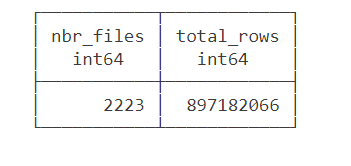
Data source is around 2200 files with a total of 897 Million rows of weird csv files (the file has more columns than the header) , This is a real world data not some synthetic dataset, it is relatively small around 100 GB uncompressed.

The Pipeline will read those files and extract clean data from it using non trivial transformation and save it as a Delta Table.

we used the smallest Compute available in Fabric Notebook which is 4 cores with 32 GB. to be clear this is a real single node (not 1 driver and 1 executor), Although the Runtime is using Spark, All the Engines interact Directly with the Operating system, as far as I can tell, Spark has a very minimum overhead when not used Directly by the Python code.

You need to pick the Engine

Nowadays we have plenty of high quality Calculation Engines,  but two seems to gain traction (Polars and DuckDB) , at least by the number of package downloaded and the religious wars that seems to erupt occasionally in twitter 🙂

For a change I tried to use Polars, as I was accused of having a bias toward DuckDB, long story short, hit a bug with Polars , I tried Datafusion too but did managed to get a working code, there is not enough documentation on the web, after that I did test Clickhouse chdb, but find a bug, anyway the code is public, feel free to test your own Engine.

So I ended up using DuckDB, the code is published here , it is using only 60 files as it is available publicly, the whole archive is saved in my tenant (happy to share it if interested) 

The results is rather surprising (God bless Onelake throughput), I am using the excellent Python Package Delta Lake to write to Onelake

26 minutes, that’s freaking fast, using Fabric F2, the total cost will be

0.36 $/Hour X(26/60) =  15 Cents

you need to add a couple of cents for Onelake Storage Transactions.

As far as I can tell, this is maybe one of the cheapest option in the Market.

0.36 $/Hour is the rate for pay as you go, if you have a reservation then it is substantially cheaper.

because it is Delta Table Then Any Fabric Engine ( SQL, PowerBI, Spark) can read it.

What’s the catch ?

Today DuckDB can not write directly to Delta Table ( it is coming though eventually) instead it will export data to Delta Lake writer using Arrow Table, it is supposed to be zero copy but as far as I can tell, it is the biggest bottleneck and will generate out of memory errors , the solution is easy ; process the files in chunks , not all at once

#############################################
list_files=[os.path.basename(x) for x in glob.glob(Source+'*.CSV')]
files_to_upload_full_Path = [Source + i for i in list_files]
if len(files_to_upload_full_Path) >0 :
  for i in range(0, len(files_to_upload_full_Path), chunk_len):
    chunk = files_to_upload_full_Path[i:i + chunk_len]
    df=get_scada(chunk)
    write_deltalake("/lakehouse/default/Tables/scada_duckdb",df,mode="append",engine='rust',partition_by=['YEAR'],storage_options={"allow_unsafe_rename":"true"})
    del df

By experimentation, I notice 100 files works fine with 16 GB, 200 files with 32 GB etc

When exporting to Parquet, DuckDB managed the memory natively and it is faster too.

Native Lakehouse Is the future of Data Engineering

The combination of Open table format like Delta and Iceberg with ultra efficient Open Source Engine like DuckDB, Polars, Velox, datafusion all written in C++/Rust will give data engineers an extremely powerful tools to build more flexible and way cheaper data solutions.

if I have to give an advice for young Data engineers/Analysts, Learn Python/SQL.

Would like to thanks Pedro Holanda for fixing some very hard to reproduce bugs in the DuckDB csv reader.

And Ion Koutsouris for answering my silly questions about Delta lake writer.