Fabric Preview Pricing Misconception

Edit : How many physical cores a service is using is considered an internal implementation, for example Snowflake don’t publish those numbers nor BigQuery, Redshift etc, for a simple reason those numbers may change when the vendor upgrade their compute layer, I am not asking for this information, I am mainly talking about the compute unit ( CU), which is a virtual unit like BigQuery Slot, today we don’t have this information for a lot of items, as a customer, I don’t think it is too much asking.

Introduction

One very confusing aspect of Fabric preview is that the usage pricing is not public yet, early adopters get confused when people ask for pricing, their reply, the pricing is public and they show this blog post with the pricing table 

The table shows you only the price for Every SKU and how much compute you will get, but it does not tell which size to use to support your workload, nor what’s the performance of the different Engines in Fabric

Just do a POC and see how it goes 

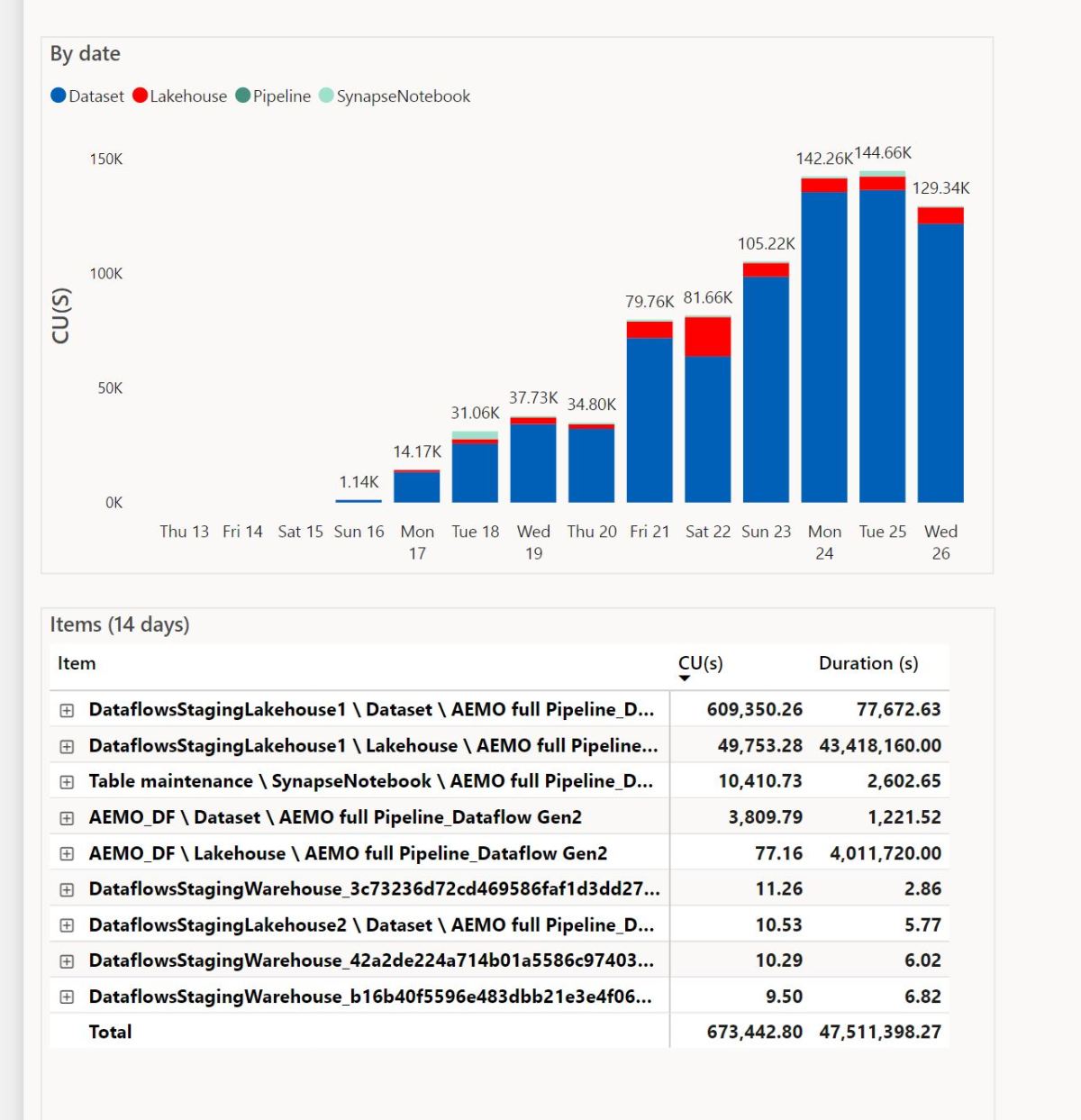
It is free in Preview, just do a POC and attach a free trial capacity, that’s a good way to learn how the system works, but today, it does not tell you how much compute it is using as the Workload for DWH and Dataflow Gen2 is not reported, for example, I built a  full end to end report in Fabric using Dataflow Gen2, OneLake and Direct Lake mode in PowerBI

It was a good exercise, I definitely learnt new skills, but I have no idea how much compute unit (CU) this solution will consume from my capacity, what’s reported here is only some items that show their usage data but not dataflow Gen2 ( some items like the default dataset should show 0 but that’s a bug, it is a preview after all)

Spark is the Good Guy 🙂

Spark Engine do report the usage from day 1, what you see is what you will get in the GA or even better (but not worst), same solution using Spark

I can say useful things about Spark performance because I can see the numbers, I know exactly how many compute unit (CU) it is using,  I don’t have the slightest idea about Dataflow Gen2 nor Fabric DWH.

Can we Talk about Fabric Performance ?

No, today we can’t, you simply can’t say anything meaningful about the performance if you can’t see the usage numbers, for example, I ran Query 1 of TPCH_SF10 ( that’s 60 million rows),  it took 1 second, that’s pretty good, is it performant though ? again I don’t know how many compute unit it is using.

What does it mean

I have mixed feeling about it, a charitable take, they are just fine tuning some numbers, another take, users can be a little bit uncomfortable  that 2 months in the public preview and no indication on the pricing is a bad sign, I don’t know and I don’t think it is useful to speculate, but if you are using fabric today in preview don’t assume this is the whole story, we will get the full picture only when we see all the usage information. 

And again, I am not suggesting, it is not performant, all what I am saying is, we don’t know today, the only Engine we can talk about is Spark because they are publishing their usage numbers. 
PowerBI Direct Lake misconception

The first time I used Direct Lake I was blown away by the performance, it was just too good to be true,import performance with nearly instant refresh time, a month later, I have better understanding, the first impression is still valid but it is more nuanced, there is always a tradeoff 

Import Mode

Let’s take a simple analytical pipeline using PowerBI service, reading a csv file from a web site, you will have something like this

Ingestion : 

  • Download the csv
  • Sort it, and Compress it  and save it into PowerBI Proprietary columnar file format in Azure Storage

Query : 

  • When a Query arrive in the service load the columns from PowerBI file in Azure Storage to the Server RAM

When people use import mode they usually means those two stages (Ingestion and Query), refresh in import mode means ingest new data and load it to RAM

Direct Lake Mode

In Direct Lake mode, more or less the Query stage is the same, that’s a great technical achievement from the Vertipaq team, instead of scanning PowerBI storage file, you do the same for Parquet

But here is the catch: refresh is nearly instantaneous because it is not doing much, the ingestion of new data did not magically disappear but has to be done elsewhere.

Who does the Ingestion then ?

You can use Spark, Dataflow Gen2 , Fabric DWH etc to create and update the Parquet files, or if you are lucky and your system produce Delta lake tables with the right file size etc, you hit the jackpot 

Why you may not want to use Direct Lake

  • It is a Fabric only feature.( edit : you can use shortcut to an existing Azure storage bucket , but you still need OneLake running, Hopefully one day, we can run Queries directly from an object store using PowerBI Desktop)
  • You use calculated column, calculated table
  • If your users interact with the data using only PowerBI reports then it is not worth the added complexity.
  • It does not work with PowerBI desktop, my understanding, it will fall back to Fabric SQL Engine.
  • Storing all the tables and metadata in one file is a very powerful concept and works very well in the desktop, which is still the main development environment for users.
  • Not specific to PowerBI but usually for pure performance , proprietary Storage files are faster for the simple reason, they are super optimized to the Query Engine and have no compatibility requirement.

Why you may want to use Direct Lake

  • If you have a use case where import mode was painful or literally did not work.
  • Somehow you have a system that produces Delta Lake Tables with the right file size and row groups.
  • Because ingestion is done outside PowerBI, you may get less memory pressure which is still the biggest bottleneck in PowerBI.
  • You want to share Data to non PowerBI users.

What will be really nice.

Today Both import and Direct Lake don’t push down filters to the storage file, I think there is an expectation that BI Query Engine should support data that don’t fit in memory.

It will be nice too if Direct Lake support more table format like Hive and Iceberg

Fabric as a OS for analytics 

Introduction

Was listening to this short Video (Fabric Espresso: Will Fabric replace Azure Synapse?) and the VP of Synapse described Fabric as the OS for analytics, and I think it is not simply marketing talk but they are into something, This short blog will show that using DuckDB in Fabric maybe a useful scenario.

OneLake Throughput is the unsung hero of Fabric 

I tried to run DuckDB before in the cloud and all the systems I used Google Colab, Cloud functions, AWS Sagemaker etc have the same limitation, The throughput from the remote storage is just too slow, Fabric Onelake which is based on Azure ADLS Gen2 has an amazing throughput see this example

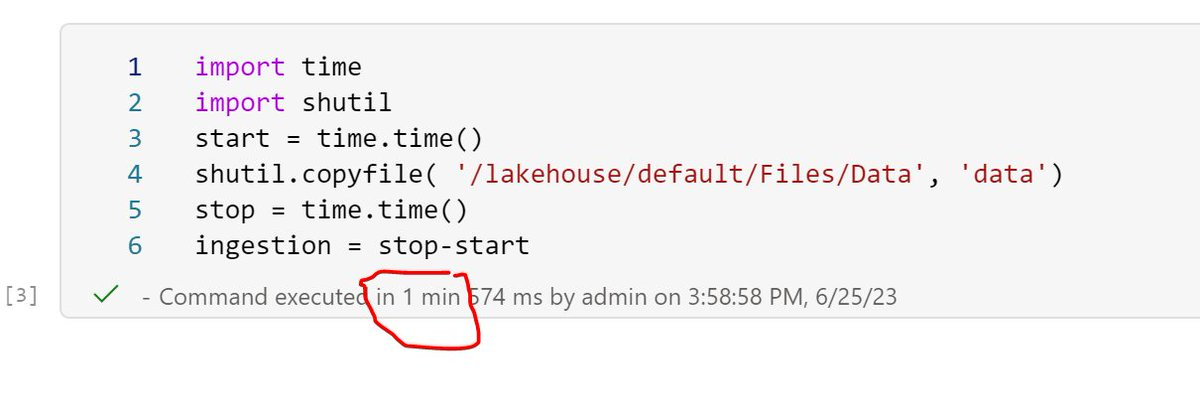
The file size is 26 GB , that’s nearly 433 MB/s, this is simply amazing, as a reference last week I bought one of those cheap USB flash drives and the read speed was 132 MB/s.

DuckDB reading Directly from Remote Storage

DuckDB is very fast when reading from a VM SSD especially when using the proprietary file format, but realistic speaking users in fabric would probably be more interested in reading directly from the Delta table, so I avoided creating another copy with DuckDB storage file.

I  test  two approaches

  • Import the data into Memory and than run the queries
  • Run the queries Directly from OneLake

The script is available here, the main Table is rather small 60 million rows, I am using just 4 cores, and the results are very interesting

32 second to import to Memory this includes decompressing and rewriting the data using DuckDB format (in RAM), but it is done only once.

24 seconds to run the Queries using 4 cores, just to give you an idea , another famous lakehouse vendor when using the same data, The Engine requires 16 cores and finishes the queries in around 40 seconds.

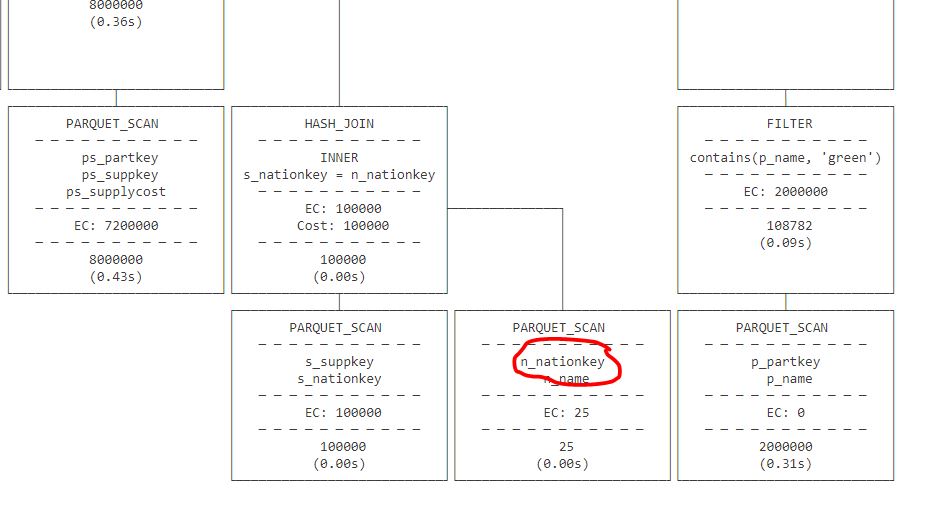
Running the queries directly from OneLake took 58 seconds, I notice though that Query 9 is particularly slow, which usually means a bad query Plan.

I run a profile on that Query and indeed when running directly from Parquet, DuckDB got the join order wrong, as DuckDB ignore the stats when reading from Parquet ( according to the dev, most stats in parquet are wrong anyway)

Note : I use Delta lake package to get the correct list of Parquet files to read, you can read directly from Delta using arrow dataset but it is slower.

Take away

In The medium term, we can imagine Fabric supporting More Engines. There is already some talks about SQL Server (although Parquet is not designed for OLTP, but that’s another subject)  The storage layer which is the foundation for any analytical work is very solid, the Throughput is very impressive, let’s just hope we get a lighter VM to run smaller workloads.

DuckDB currently does not support Buffer pool when reading from remote storage, I am afraid they need to add it. Microsoft supporting Delta has changed the market dynamic and DuckDB can’t ignore it. Parquet alone is not enough, we need those Delta stats for better Query plans.

Save Fabric Delta Tables as DuckDB file

The file section of Fabric Lakehouse is very interesting as although it is a blob storage, somehow behaves more or less like a real filesystem, we leverage that to save all Delta Tables in one DuckDB file

Limitation

  • DuckDB storage format is experimental at this stage and doesn’t offer backward compatibility yet, everytime they upgrade a major version, you have to export the file to parquet and import it back.
  • I am using Python Deltatlake package to read the Delta table, currently it supports only Delta reader version 1, which Microsoft uses, but this may change in a future update of Fabric.

How it works

Install DuckDB and Delta lake, and copy this function

The data will be saved for the current version of the table, old data not removed by vacuum will be ignored.

A note about concurrency

You can have multiple readers using the file at the same time (Using read_only=True), but multiple writers is  not a supported scenario nor 1 Writer and multiple reader, use at your own risk 🙂 Having said that, in the case of 1 writer and multiple reader the worst case scenario is reading inconsistent data 🙂